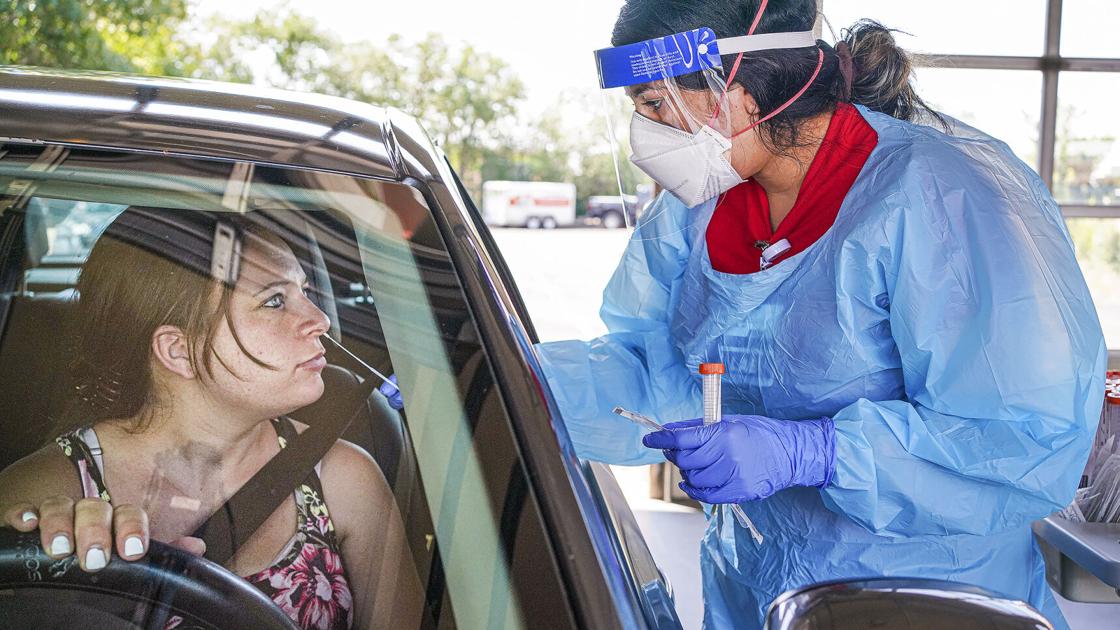
After an all-too-short reprieve, the number of COVID-19 cases has steadily increased in New Mexico since July when Gov. Michelle Lujan Grisham opened the state back up for business and lifted a series of unpopular restrictions.
Expect the troubling trend to get worse.
“We have a lot of alarming information today, but we’re pretty much all convinced that we are headed for about 1,000 cases a day by the end of this month,” Dr. David Scrase, the state’s human services secretary and acting secretary of the Department of Health, said during an information-packed news conference Wednesday.
“All of the tracking and modeling that’s being done around the country and here in New Mexico shows the same result,” he added.
Southeastern New Mexico, which has the lowest vaccination rates in the state, is facing an even more serious problem, Scrase said.
Modeling from Los Alamos National Laboratory projects up to 1,250 cases per day just in the southeastern part of the state in early September.
“Just talked to the regional hub hospital there this morning, and they’re seeing much higher rates of ER visits,” Scrase said.
Case counts across the state this week are nearly 10 times higher than they were in the first week of July.
On Wednesday, the state Department of Health reported 713 new cases, up from 688 the day before. New Mexico hadn’t had a case count as high as Tuesday’s since Jan. 30, when it reported 741. The state also reported an additional seven COVID-19-related deaths, bringing the total to 4,437.
“I know everybody’s in tune to the news, but we are seeing a really rapid rise in cases [across the nation], also hospitalizations and deaths,” said Dr. Christine Ross, the state epidemiologist. “So, trends have been going absolutely in the wrong direction, and this seems to be mostly fueled by this very highly contagious delta variant.”
Ross said “human behavior” also is a factor in the increase.
“We’re all exhausted,” she said. “We are seeing our friends and family. We are traveling. We’ve gotten back to life as normal and, unfortunately, that does give opportunity to this virus to transmit from persons to persons.”
During the news conference, Ross displayed a slide on the levels of community transmission nationwide.
“We are, unfortunately, in a sea of red here, which indicates high levels of transmission,” she said, adding about 1 in 10 people who get a COVID-19 test right now are getting a positive result.
Ross said she’s been keeping her eye on Louisiana, where she lived and did her medical training.
“There happen to be large pockets of people that are unvaccinated and are not protected against this terrible virus, so they really are being quite heavily hit right now, and it’s impacted their health care delivery system,” she said. “They aren’t able to adequately manage the number of COVID-19 cases that need hospitalization and also manage, properly, all of the other people seeking care, whether it’s for a heart attack or stroke.”
The bottom line, Ross said, is state health officials don’t want New Mexico to follow suit.
“We have the tools to keep us ourselves out of that same situation,” she said. “The best way that we can protect ourselves, the vulnerable people amongst us, our children who are not eligible yet for vaccination, is for every single person who is eligible to go out and get vaccinated — now.”
As the delta variant fuels another surge, New Mexico is facing a nursing shortage, prompting a call from Scrase for retired nurses “to look for open opportunities and help us all fight back this new variant.”
According to the Centers for Disease Control and Prevention, the variant is now the predominant strain of the virus in the United States. It is nearly twice as contagious as previous variants, and some data suggests it might make unvaccinated people sicker than previous strains, the CDC reported.
Scrase said 74.2 percent of New Mexicans 18 and over have received at least a first shot of the vaccine, and 65.5 percent are fully vaccinated.
“We still have 11 counties with less than a 50 percent rate,” he said, adding New Mexico is still among the top 10 states in the nation in vaccination rates.
Among New Mexicans between 12 and 17 years old, 53 percent have received at least one shot, and nearly 41 percent are fully vaccinated. The lowest percentage of fully vaccinated New Mexicans over 15 is among 18- to 24-year-olds, he said.
Though he tested negative, Scrase is in quarantine after spending “a fair amount of time with a good friend” who tested positive for COVID-19 after they attended a government-sponsored event last week. Scrase said he was double-masked at the event — “thank goodness” — and encouraged New Mexicans to wear tight-fitting face coverings in indoor public areas even if they’re vaccinated.
“This is a real thing,” he said. “It changes how we think about things, and it’s an added reason why we should all get vaccinated [and also] start wearing those masks again.”
Scrase also sounded the alarm over what he called “internet-based misinformation,” saying he knows people who have died from following bad medical advice.
“The level of misinformation that people are sending me in my email and that I’m seeing out on the web and social media has become alarming,” he said.
“My wife has a person, actually, in her extended family who died recently of COVID-related misinformation,” Scrase added. “We got a call [asking if we could] get her a vaccine in the hospital. She was on her deathbed and, of course, that doesn’t help.”
Though he didn’t play it, Scrase displayed a CNN story of a man fighting for his life in a hospital bed, talking about how he regretted not getting the vaccine.
“I’m not really bringing these up to be overly dramatic,” he said. “I just want to make the point that as a physician, misinformation is becoming a major risk factor for death from coronavirus.”
Related Posts
