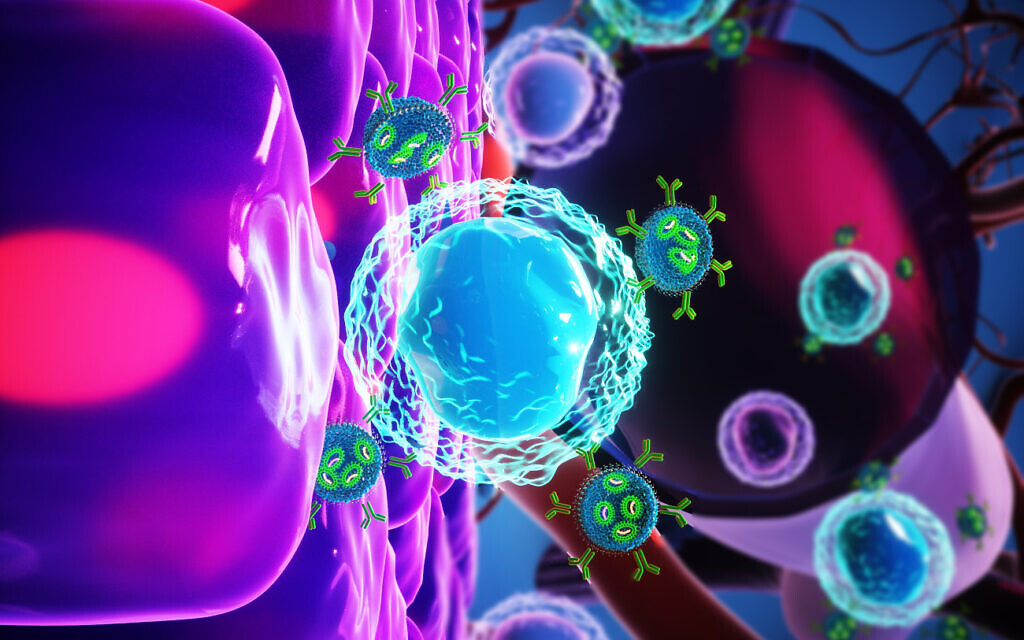
Israeli “GPS-guided” nanoparticle drugs can tackle inflammation without touching healthy immune cells, scientists say, calling the innovation “game-changing” and predicting it could replace antibody therapeutics.
“Instead of today’s treatments for inflammation, which are felt across the body, we’re sending ours with a GPS of its own that takes it to precisely the right cells in the body,” said Prof. Dan Peer, vice president for research and development at Tel Aviv University.
Peer has tested the injected drug on mice, found it as effective as familiar antibody treatments, and outlined the achievement in the peer-reviewed journal Nature Nanotechnology.
The technology uses ribonucleic acid or RNA, a major growth area in scientific research today, as pharmaceutical companies invest more in developing RNA therapeutics and vaccines, following the success of RNA-based coronavirus shots.
“Our injection is so precise that it’s akin to a GPS that takes you not just to the right street, but to the right room in the right apartment in the right apartment building,” Peer said.
Peer, whose past innovations include RNA technology licensed by BioNTech, Pfizer’s partner in developing its coronavirus vaccine, said that he hopes to begin human trials within two years.
“This is research that could well pave the way for treatment of inflammation to shift from antibodies to carefully targeted and highly effective RNA therapies,” he said.

Inflammation in human lungs (sompong_tom via iStock by Getty Images)
Peer said the development has implications for all inflammatory diseases, various viral diseases such as the coronavirus, and, when the method is further developed, blood cancers.
The injection sends RNA-based drugs, in special nanoparticles, to receptors on cells where there is inflammation, and the drugs then “silence” or even edit the gene that is causing inflammation.
“We are the first research team in the world to succeed in creating a drug delivery system that knows how to bind to receptors only on inflammatory immune cells, and to skip over the other identical cells,” said Peer. “In other words, we deliver the drug exclusively to cells that are currently relevant to the disease.”
Peer said that such pinpointed anti-inflammatory treatments could replace today’s therapeutic antibodies, which circulate around the whole body after being administered. To treat an average inflammation only 15% of T-cells need antibodies, but today’s treatments take antibodies to all T-cells.

Prof. Dan Peer (courtesy of Tel Aviv University)
“The problem is that the antibodies work by reducing the functionality of the body’s T-cells because some of them are causing inflammation, even though it’s actually only a small proportion of the T-cells that cause the inflammation.
“Other T-cells are needed for the immune system, but left inactive by antibody treatments, which is undesirable. Now, instead of suppressing the whole immune system, we have a way to target only the cells that are actually causing inflammation,” Peer said.
I’m proud to work at The Times of Israel

I’ll tell you the truth: Life here in Israel isn’t always easy. But it’s full of beauty and meaning.
I’m proud to work at The Times of Israel alongside colleagues who pour their hearts into their work day in, day out, to capture the complexity of this extraordinary place.
I believe our reporting sets an important tone of honesty and decency that’s essential to understand what’s really happening in Israel. It takes a lot of time, commitment and hard work from our team to get this right.
Your support, through membership in The Times of Israel Community, enables us to continue our work. Would you join our Community today?
Thank you,
Sarah Tuttle Singer, New Media Editor
You’re serious. We appreciate that!
We’re really pleased that you’ve read X Times of Israel articles in the past month.
That’s why we come to work every day – to provide discerning readers like you with must-read coverage of Israel and the Jewish world.
So now we have a request. Unlike other news outlets, we haven’t put up a paywall. But as the journalism we do is costly, we invite readers for whom The Times of Israel has become important to help support our work by joining The Times of Israel Community.
For as little as $6 a month you can help support our quality journalism while enjoying The Times of Israel AD-FREE, as well as accessing exclusive content available only to Times of Israel Community members.
Related Posts
