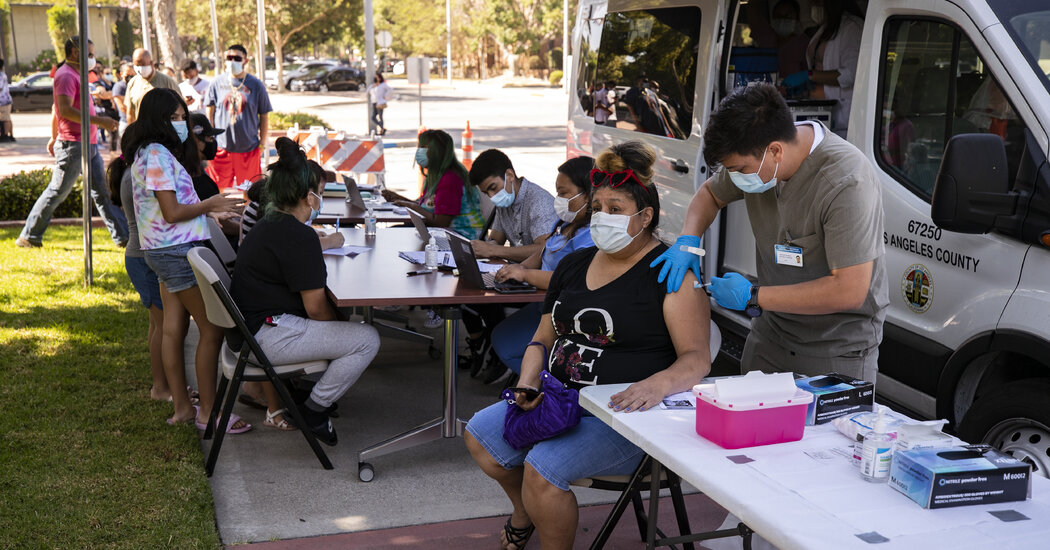
The Food and Drug Administration granted full approval to the Pfizer-BioNTech coronavirus vaccine on Monday, paving the way for more employers, schools and other organizations to mandate the shots.
“If you are not vaccinated, let this be the milestone that gets you there,” California’s public health officer, Dr. Tomás Aragón, said after the announcement.
Experts say that the highly contagious Delta variant not only presents an unprecedented threat to those who are not vaccinated, but has also provided ample evidence of the effectiveness of the vaccines.
In California, unvaccinated people are more than six times as likely to contract the coronavirus than those who have their shots, according to state data released on Monday.
And in Los Angeles County, the state’s most populous, an unvaccinated person is as much as 25 times more likely to be hospitalized with the disease.
“That, in a sense, is our proof that vaccines work,” said Dr. Robert Kim-Farley, an infectious-disease expert at the University of California, Los Angeles’s Fielding School of Public Health.
Similar to how states with low vaccination rates have been hard hit by the latest surge of the coronavirus, so have California counties where large swaths of the population remain unvaccinated.
Of the 20 California counties with the highest proportion of residents currently hospitalized with the coronavirus, 19 have a vaccination rate below the statewide average of 55 percent, according to The New York Times’s coronavirus tracker. (The percentages include children under 12 who are not yet eligible for the vaccines.)
Some of the most heavily affected counties in California are Yuba (36 percent vaccinated), San Bernardino and Butte (both 42 percent).
By contrast, the counties with some of the lowest hospitalization rates include Marin (75 percent vaccinated), Santa Clara (71 percent) and Santa Cruz (64 percent).
The proliferation of the Delta variant has revealed a pattern that was less clear when the virus wasn’t circulating as widely, Kim-Farley told me.
“In a situation like this where we’re seeing basically Covid everywhere,” he said, it is easier to see the strong correlation between higher vaccination rates and lower rates of disease.
Still, additional factors may be at play, experts say.
A recent survey by the University of Southern California found that people who were unvaccinated were more likely than the vaccinated to go to a bar or a friend’s house and less likely to wear a mask or avoid large gatherings.
In other words, people who choose not to get vaccinated are also probably less worried about Covid-19 and take fewer safety precautions, contributing to their risk of falling ill, said Kevin Malotte, a professor emeritus of epidemiology at Cal State Long Beach.
“Lack of mask measures, lack of worry about it, lack of vaccination are all kind of the syndrome, and I think that’s what we’re seeing correlate with the high rates,” Malotte told me.
For more:
What we’re eating
Enjoy a creamy and mild eggplant salad made with a quick dressing of yogurt and seasonings.
Where we’re traveling
Today’s California travel tip comes from Joanne Devereaux, a reader who lives in Oakland. Joanne writes:
On a clear day Mt. Tamalpais is visible to many thousands of people living in the Bay Area. At 2,500 feet of elevation, it can be seen from so many vantage points. You can hike the many trails leading to the top of Mt. Tam. On a foggy summer day, it’s amazing to experience hiking above the fog layers to look down at the iconic Golden Gate Bridge, Angel Island, Alcatraz and, if you are lucky, the Farallon Islands. An intrepid traveler might even stay overnight at the West Point Inn, which allows a respite from a long (but well worth it) hike.
Tell us about the best spots to visit in California. Email your suggestions to CAtoday@nytimes.com. We’ll be sharing more in upcoming editions of the newsletter.
And before you go, some good news
Chaffey College in Rancho Cucamonga has received a nearly $3 million grant to help train students in welding, a growing but overlooked industry, reports LAist.
Officials from Chaffey, a community college, say that the funding will be used to “support students who are the first in their families to go to college, students of color and those from low socioeconomic backgrounds.”
Thanks for reading. I’ll be back tomorrow. — Soumya
P.S. Here’s today’s Mini Crossword, and a clue: “I’m to blame for that,” slangily (3 letters).
Mariel Wamsley contributed to California Today. You can reach the team at CAtoday@nytimes.com.
Related Posts
