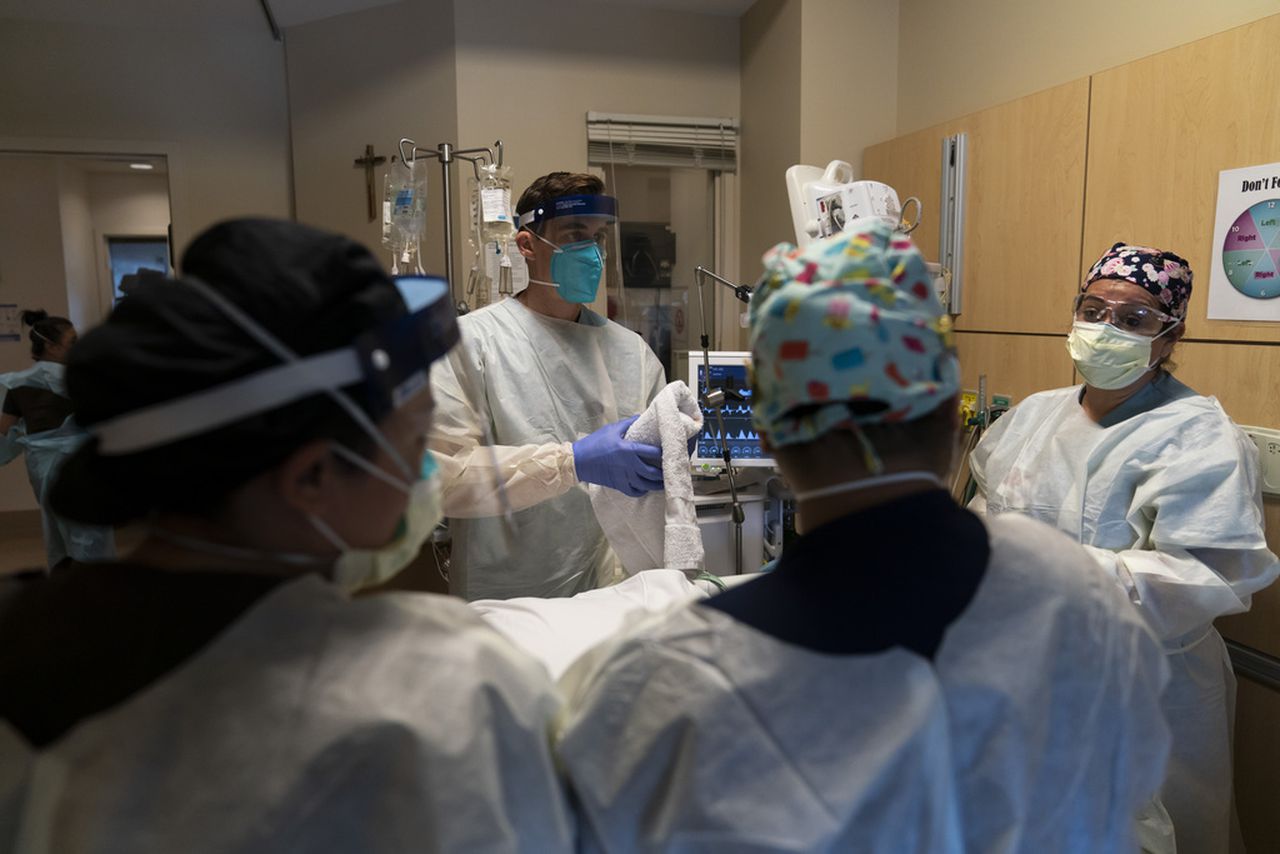
Dr. Jenna Boyd Carpenter, a pulmonologist and intensive care doctor in Guntersville, recently shared an emotional Facebook post describing what she has seen as COVID numbers spike in Alabama, including younger patients hospitalized in what she has called a “truly heartbreaking week.”
Alabama Department of Public Health figures show the state added 3,799 coronavirus cases to its total since Thursday, bringing the total since March 2020 to 653,540. Marshall County added 85 cases, bring its total to 14,436.
AL.com spoke to Dr. Carpenter about why Alabama hospital staffs like hers are exhausted, why she’s emotionally drained from treating COVID patients at the end of her day and what it will take for people to finally trust the medical experts and get vaccinated.
I know moments before you joined me, you were seeing patients. Has today been a good day?
Dr. Jenna Boyd Carpenter: You know, we have had a good day. My two partners, on the other hand, are not having a good day. They are both in the COVID ICU. Usually the way we operate is I have two partners — Dr. Jeff McCartney and Dr. Chris Manganaris — we have literally all pulled together to support each other. They are not having a great day because they are in the COVID ICU today, and I’m in clinic. I do know earlier that Dr. McCartney was having issues with a critically COVID ill patient in the ICU. Dr. Manganaris has had similar things going on at the other hospital. Unfortunately, us being a small hospital, we’ve run out of room a lot quicker than the big facilities do. We don’t have as many beds. That does hurt us. We have 12 ICU beds at our south hospital. Every one of them is full. It’s a complete COVID ICU unit at this point. The other hospital, we’re actually only able to operate six out of those eight beds.
The medical system, like everybody else, we go down the highway and you see “Now hiring” at every place you pass. We are no different. We lost people the first go-around back in December and January that honestly took a career change. They said “I can’t do this anymore.” So unfortunately with a surge of patients, we are doing this much less staffed than we were in the peak of things. We’ve had our moments here. We’ve all had to work extra and overtime. Dr. Manganaris and Dr. McCartney have all pitched in on that. Each of us has had a weekend or so we were supposed to be off, and we’ve come in because the patients were too sick. We’ve needed extra help because it was too much for one person to do. This is still very real. I’ve had a better day because I’ve seen patients in the clinic today, but I’ve heard what’s going on in the hospital today. It’s real. It’s just absolutely real. And the problem is I don’t see this slowing down anytime soon, which tremendously worries me. These patients are younger, they’re sicker, and they seem to be getting sicker faster. And it’s quite disturbing.
Can you please explain what you do as a a pulmonologist and intensive care physician day-to-day as it relates to COVID?
I am an ICU physician, or an intensivist. On a daily basis, what we do is we’re going to be taking care of any patient in the ICU that is on a ventilator. We are the primary ones that manage that with making adjustments on that ventilator as needed. We are going to be the primary person that is responsible for managing that critically ill person. As a pulmonologist, which is lungs, some of the more routine things we focus on are asthma, COPD, anybody with shortness of breath issues. We also help assisting with diagnosing lung cancer. And we manage critically sick patients in the ICU.
Primarily where our role is coming in right now is we are taking care of the sickest of the sick COVID patients. We are primarily responsible for their management in the ICU. We’re doing any kind of procedures, like putting specialized IVs in. We are the ones, with the assistants of the anesthesiologists, intubating these patients and putting them on the ventilator. If able, we’ve been trying to let these patients have a FaceTime moment or at least a phone call where they can hear their loved one’s voice because, unfortunately, when we know it gets to that point that they are sick enough to go on the ventilator, the outcome is not good. It’s really hard, knowing in your heart of hearts, knowing this is probably going to be the last time that they’re able to speak or see their loved one. I had to do that a couple of times last week. It’s truly heartbreaking seeing the patients, the families with tears in their eyes. That’s a moment I will never forget in my medical career.
You said you have held so many hands and you’ve had FaceTime calls with families before you put patients on the ventilator because you know it will be the last time they see or speak to their loved one. People who aren’t in your line of work cannot possibly understand what that’s like, but how could you put that into words, having an idea of the outcome when you put someone on a ventilator? That’s obviously not an easy part of the job.
That’s true. A lot of times dealing with the sick patients we deal with, it’s not good news that we have to deliver. That’s a tough part of my job. I don’t like having to tell a patient “You’ve got lung cancer.” In situations like this, I really don’t like having to tell a family that they’re more than likely not going to make it. With the situations we’ve had this week, a lot of times the patients ask me “Is this going to help?” I couldn’t give you the exact numbers, but there is an extremely small percentage of patients that survive and are able to recover and come off the ventilator. And that’s still the case, all this time later. That is one of the hardest questions I have to answer, when the families or the patients look at me and say, “Am I going to do OK, is this going to help?” I try to be very honest with them in a gentle way. This is the toughest question of all to have to answer, when I have to look them in the eye and say, “There is a very high chance, after doing this, that you will not survive.” That’s gut-wrenching to have to tell somebody that. I try to reassure them. I tell them “We’re going to do everything we can. We’re going to take great care of you. We’re going to be there for you.” But that’s a hard thing to tell a patient and a family. It’s hard.
You said you’ve come home and sobbed in the shower because you are emotionally worn out. Doctors obviously have so much experience with these life or death scenarios, witnessing and relaying the news of tragedies that impact families. But how has COVID changed that for you? Why is it more emotionally draining?
These patients are extremely stressful and difficult to take care of because they are so ill. They are so sick. You are doing everything in your power and with your knowledge that you know to do, and nothing works. That, to me, is one of the more frustrating things. We do that for every patient. Every patient gets the absolute best care within our abilities. Normally, we have a lot of people that turn around, they improve, they come off the ventilator, they get well. That is not the case with this situation.
It is utterly an almost helpless feeling. We give them all the medications that we have and we know to give. And it’s like the patients just keep getting worse and worse. You turn the oxygen up as high as it will go on the ventilator. Their oxygen levels are still low. You really feel like you’re pouring your heart and soul into it and giving it 120 percent, and for the large majority with the patients when it gets to that point, they still don’t survive. It is so emotionally and clinically challenging and draining, just because of the amount of effort the nurses, the staff, the doctors, everybody is putting in — and despite that we still have these outcomes. It’s very hard to lose a patient. And the fact that it’s just so constant. Unfortunately if we have a patient pass away in the ICU, there’s another patient there immediately to fill that bed. It’s just this continuous onslaught that just doesn’t stop. The waves are beating you down, and they just keep coming. You don’t get the break. It’s this continual despair, really.
You said even though you are vaccinated, you’re highly exposed and fear that you could bring the virus home to your children because they are not old enough to be vaccinated. Could you elaborate on that fear you have? How do you remain on guard when you’re at work while face-to-face with patients, all while giving them the best possible care and trying all you can to prevent bringing it home to your children?
As we try to be as safe as we can be, every time we go in these rooms in full personal protective equipment…when I go in these rooms, I have N95 masks on. I’ve got a protective gown, a face covering with goggles, and a head covering. We change that out going between rooms. I’ve had times when I’ve gotten home, and literally. I’ve closed the door to the garage and said, “Everybody go in your room.” And I’ve had to take my clothes and put them straight into the laundry room and go straight to the shower, just because you’re scared. You want to minimize the risk to anybody else as much as you can. So we take great strides with trying to protect ourselves and be as careful as we can.
The delta variant is scary to me. I think it should be to a lot of people. All the data that we’re seeing on this — more contagious, more easily spread. So it’s spreading easily. It is targeting that younger population that doesn’t have a lot of comorbidities or underlying health issues. Still almost two years into this now, there’s still sometimes a struggle to get supplies. The struggle for certain things is still there and not necessarily significantly better than it was 18 months ago. But we try to be as careful as we can. But I do fear for my kids. I have put them in masks to go to school to help protect them. The best thing that we can do for our children is, for us that are old enough, is to get vaccinated. That helps protect them as well, in your household. Certainly I worry about my kids on a daily basis. I don’t worry about myself as much. When this first started, I think we were absolutely terrified. I’ve never been trained for how to deal with a pandemic. None of my colleagues have either. None of us ever thought in our lifetime or medical career that we would be faced with something like this. As more time as gone on, we put our PPE on, we get in the room, we take care of what we need to do. That thought is still back there of I’m at risk. I try to put it in the back of my mind so I can focus on my job and take care of the patient the best I can. But I would say we’re all worried.
You wrote that “the entire medical staff is severely hurting and worn out,” that you’re exhausted and had not recovered from the worst of it before this latest surge in cases and hospitalizations, and the numbers continue to trend in a troubling direction. What do you mean when you say the staff is hurting and worn out? Could you paint a picture of that so people understand what you’re going through?
It’s kind of the analogy I mentioned earlier, you’ve got this constant wave of tragedy and sickness and death that is just continually beating you down. You feel like you cannot get your head above water before the next round comes. You have that unfortunate patient that declines and dies. And right behind it, here we’ve got another mid-40-year-old coming in from the ER that’s on the verge of getting on the ventilator. Our surgery nurses have had to be pulled to our surgery recovery area to open up an overflow ICU because our ICUs are completely full, so what we’ve been having to do is open that unit down there. Well, that takes extra staff. These folks are having to step up, work over, to have that particular area covered 24 hours a day. We’re short-staffed, just like everybody else.
That, along with the emotional part…it’s not just the patients. You have somebody young you’ve lost, you have to administer that poor family. The tears, the cries, the wailing, the despair. It really, really, really takes a toll on all of us. That’s the best way I know how to put it. It’s a barrage of emotions that gets exhausting. You got home at the end of the day, and you think, “I wonder how they’re doing…” So you bring this home and think about these patients, and it’s not something that stops at work. A lot of times you have more them when you have a quiet moment. That’s the time I struggle. One of our ER doctors, Dr. Tyler Hughes, posted his personal story. He has had to put multiple patients on the ventilator. He talks about trying to FaceTime families, let them speak to their loved one, what a challenge that’s been. It’s nice to hear from the normal people like us, hopefully that will help the public get the inside story on the severity of what’s going on, but how much we’re all struggling.
You’ve called the vaccine a “powerful weapon,” saying that while no vaccine is perfect, you have a reduced risk of getting ill to the point you need hospitalization. Doctors like you have been steadfast in this messaging — that the vaccine is safe and effective — but so many people remain unconvinced and are ignoring medical expertise on this. What do you think it will take to finally convince people to get vaccinated in Alabama?
One reason I’m hoping by more of us stepping up by sharing our personal experiences — not so much to come to people with the science and statistics, like we’re trying to shove it down their throat — I think there’s been a lot of negativity unfortunately about the vaccine, and it didn’t necessarily have to be that way. I don’t think people like to feel like they’re forced to do anything. I almost feel like the second you try to mandate or force something, people get resistant to that. This is the part I don’t think they’re seeing. I don’t think folks are realizing the age of patients we have in the hospital now, that the large majority of them are unvaccinated, that we are rapidly losing patients. If this keeps going in the trajectory it is with the graphs I’m looking at, we are headed number-wise back to where we were in December and January. In my opinion, this is significantly worse than it was at that time for several reasons, because patients are getting so much sicker, and this younger group that’s being affected; whereas before, I feel like people had a false sense of security of “I’m young. I don’t have any underlying medical problems. I don’t need to get vaccinated, because it’ll be OK.” That’s not the case now. That’s the message we’re trying to get out there, that I don’t want young patients — or any patient — to fall into that false sense of security.
I will admit, Alabama’s vaccination rate is very disappointing. I hope that we as a state, and even as a nation, will start to work together to improve this. I fear this pandemic is going to continue go on. I don’t like the momentum of where we’re seeing things right now. I don’t want more people to needlessly continue to die before it comes to the point to convince people to get this done. People are worried about the side effects. I’ve had multiple patients tell me “I’m scared.” My response is “I’m terrified for you not to get the vaccine. With what we’re seeing going on in the hospital right now, if you’ve got COVID, I fear for you.” My patients have lung problems. So yes, that does worsen their potential bad outcome as well. That’s not all what we’re seeing. Now it’s more younger people with not as much of that going on. The risk of getting COVID, I can confidently say, far outweighs the risk of vaccination. Every single medication we take — antibiotics, herbal supplements, other vaccines — Everything has a risk of side effects. The COVID vaccine is no different. However, these particular side effects, I can tell you are much greater if you end up getting COVID. I reach out as a plea, from the bottom of my heart, to the residents of Alabama, let’s do this. Let’s move forward. Let’s do what we can to help ourselves and take care of each other.
In your experience, after sharing your story and describing the frustrations among your medical staff and the stress this is putting on hospitals, have you found cause for hope in terms of convincing people to get the shot? Do you get the sense the message is getting through to people, even just incrementally?
I really do. I really feel like I was at the point where I needed that encouragement. The people I don’t even know that have personally reached out to me with messages saying “We stand by you. We’re fighting for you.” The numerous comments encouraging people to get their vaccine. I’ve had a few that have reached out to me personally that said “I was on the fence. What do you think?” I was thrilled just to open up that avenue of conversation and maybe to get people thinking about this in a different way. It isn’t “Well you need to do this because we said so.” It’s, “We recommend it, but let me tell you from the bottom of my heart why and what I’m seeing.” I have been completely overwhelmed by the calls, text messages, people reaching out through social media. This has gone way beyond what I ever would have imagined. It’s really been fantastic. It’s been a great opportunity and has really opened the door for discussion.
Related Posts

小学生 ラブドール ダッチワイフのような生活との性的共存における真の夢
nettsted for sexdukke https://no.yourdoll.com