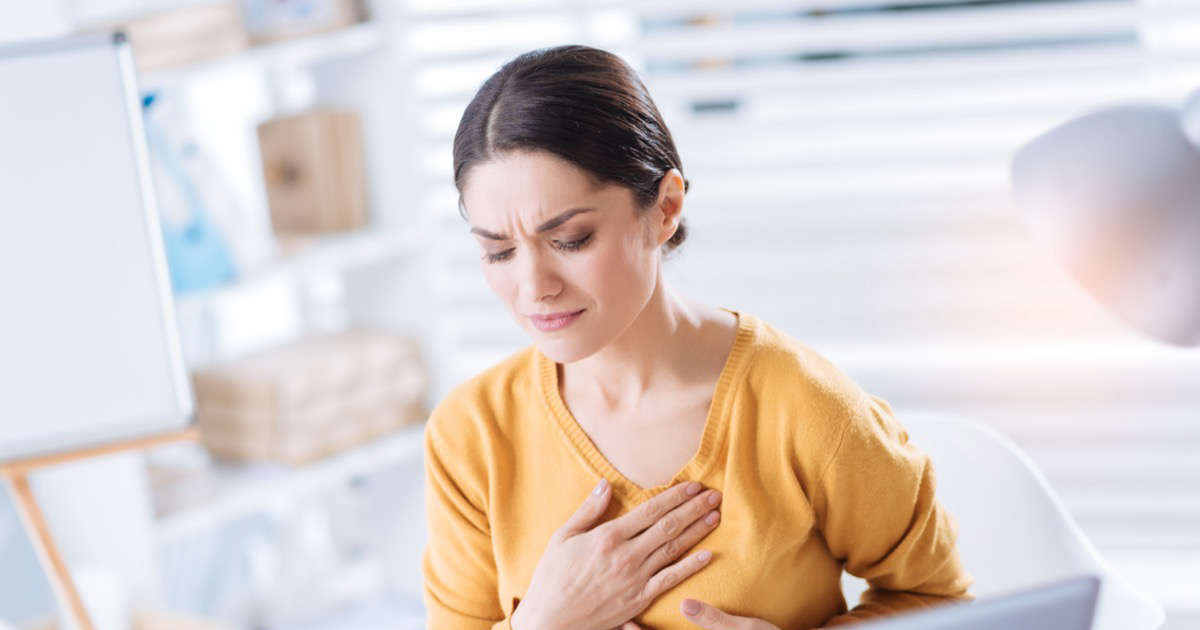
We all know the classic symptom of heart disease—chest pain. But a serious disorder like heart trouble can also show up with symptoms that are unusual, slight, or ambiguous. These are seven sneaky signs of heart disease that experts say should have you on red alert, including precisely what kind of chest discomfort you should look out for. Read on—and to ensure your health and the health of others, don’t miss these Sure Signs You Have “Long” COVID and May Not Even Know It.


Aside from the classic symptom of chest pain, “I usually tell patients that any new symptom that occurs with exercise is something to pay attention to,” says Nicole Weinberg, MD, a cardiologist at Providence Saint John’s Health Center in Santa Monica, California. “For example, say you newly get nauseous with your workout. That is something we would need to further and more closely examine to find out what the cause is.”
A golden rule: “If a symptom comes on, particularly with exertion, and doesn’t abate for five minutes, you should call your doctor or report to the ER,” says Weinberg.


“Certainly the most urgent sign remains chest pain, but not every chest pain is cardiac,” says Robert Greenfield, MD, a double-board-certified cardiologist and lipidologist at MemorialCare Heart & Vascular Institute at Orange Coast Medical Center in Fountain Valley, California. Here’s how to tell: “Classic cardiac pain is a heavy discomfort in the center of your chest that feels like a tightening or squeezing. It may radiate down your arms—usually the left arm or both arms—and may be associated with shortness of breath and possibly a cold sweat.”
If chest pain comes on with exertion and goes away with rest, it’s called angina, “and that may be a critical warning sign that your heart is in trouble.” says Greenfield. “Angina pain lasts a few minutes, but if the pain is prolonged, then 911 may be the best next step.”
Getting medical help when you experience chest pain can be lifesaving—particularly if you are in middle age or older, and you have risk factors such as high blood pressure, diabetes, or high cholesterol. “Always err on the side of caution,” says Greenfield. “Some people mistake the symptom as indigestion or a muscle pull, but a correct diagnosis can only be made by a healthcare provider.”


“There are many conditions that can cause fatigue,” says Bobbi Bogaev, MD, a cardiologist and medical director for Abiomed. “Yet persistent, unexplained tiredness with normal daily activities requiring you to stop to rest or catch your breath could be a sign that your heart is not pumping well.”
RELATED: 5 Ways to Prevent Dementia, Says Dr. Sanjay Gupta


“Heart disease can affect anyone, even those who think they are healthy, are taking care of themselves, and think they are not at any risk. It’s crucial for everyone to watch for early warning signs and address them before they turn into something more serious, like a heart attack,” says D.P. Suresh, MD, cardiologist and executive medical director at St. Elizabeth Heart & Vascular Institute in Edgewood, Kentucky. “Keep an eye out for chest discomfort, difficulty breathing with exertion, throat or jaw pain, exhaustion with minimal activity, or an irregular heartbeat. Mild symptoms should alert you to see a physician to get your heart checked out. For symptoms that persist or come on suddenly, call 911.”


“Many people often attribute shortness of breath to being out of shape or from gaining weight, but don’t write it off too quickly,” says Dr. Bogaev. “If you find yourself gasping for air after normal daily activities such as walking up a flight of stairs, it could be heart-related.”


“Oftentimes we feel heart palpitations after drinking too much caffeine or from stress, but if you’re just sitting and reading a book and find your heart is beating unusually—too fast or unevenly—it could be a sign of heart disease,” says Dr. Bogaev.
RELATED: 7 Signs You’ve Got a “Deadly” Blood Clot Inside You


According to Sadi Raza, MD, FACC, a board-certified cardiologist in Ft. Worth, Texas, another common sign of developing heart disease is edema, or swelling—particularly leg swelling that doesn’t improve with elevation, or generalized swelling throughout the body. If you have symptoms that persist, consult a cardiologist. “You should seek more urgent advice if you experience chest pain at rest or with low levels of activities,” says Raza.
To be proactive about your heart health, says Raza, it’s important to know “your numbers”—your body mass index (BMI), blood pressure, cholesterol levels and A1c (a marker of diabetes). Your healthcare provider can assess these with simple tests. And to get through life at your healthiest, don’t miss these 13 Everyday Habits That Are Secretly Killing You.
Related Posts

Woah! I’m really digging the template/theme of this blog.
It’s simple, yet effective. A lot of times it’s hard to get that “perfect balance” between superb usability and appearance.
I must say you have done a awesome job with this.
In addition, the blog loads very fast for me on Firefox.
Superb Blog!
I am actually delighted to glance at this blog posts which carries lots of useful facts, thanks
for providing such information.
I blog often and I really thank you for your content.
The article has truly peaked my interest. I will bookmark your blog and keep checking
for new information about once a week. I subscribed to your Feed as well.